SOLAR BATTERY STORAGE GUIDE
Storing Solar Batteries Without Losing Them to Standby Drain
Share on social media
A Pakistan buyer and owner guide to warehouse records, shutdown plans and model-specific storage care, explaining why an unused battery can still lose charge.
An unused battery still needs a plan
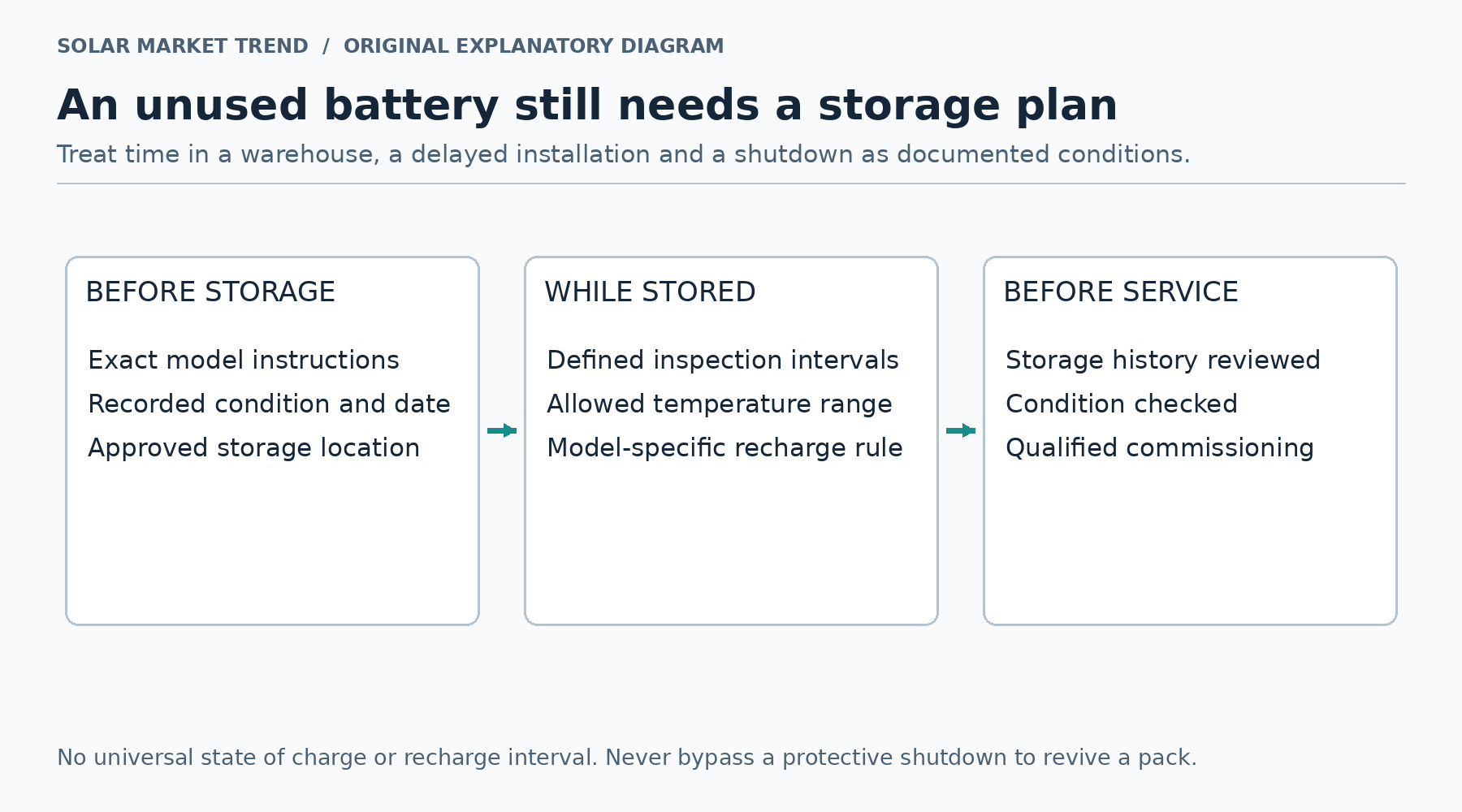
A solar battery may wait in a dealer's warehouse, sit at a building whose installation is delayed, or remain in a holiday home while its owner is away. These are different situations. A boxed module, a switched-off installed battery and a battery left supporting small loads do not necessarily have the same charge losses or care requirements.
Before buying stock or leaving a system unattended, obtain the storage instructions for the exact battery model and agree who will check it. For a Pakistani buyer comparing unfamiliar imports, that written plan is more useful than a generic assurance that lithium batteries can be forgotten for months. This guide concerns storage and avoidable discharge, not a prediction of battery lifespan.
Separate three reasons for a disappointing return
Self-discharge is charge lost through processes within a cell. Connected equipment can consume additional charge even when the household is not using it. Calendar ageing is a different issue: deterioration over time can reduce the capacity the battery can hold after recharging. Research on calendar-ageing measurements explicitly distinguishes reversible self-discharge from permanent capacity loss. [4]
That distinction matters when diagnosing a low reading after a long absence. Do not immediately conclude that the battery has permanently lost the same proportion of its capacity. Equally, do not assume every reduction is harmless and reversible. Record the starting condition, elapsed time, connected equipment and alarms so the service provider has evidence to investigate.
Small connected loads can become a large withdrawal
Victron's Lithium Smart Battery manual warns that standby loads, relays and reverse drain through charging equipment can over-discharge a battery while its system is unused. It also warns that residual current can continue to cause damage after a low-cell-voltage shutdown. That warning is product documentation, not proof that every battery has the same residual drain. [1]
Consider an explicitly hypothetical constant draw of 0.05 A for 30 days. The charge removed is 0.05 × 24 × 30 = 36 Ah. This is arithmetic, not a measured drain, a usable-capacity estimate or an instruction to discharge a battery that far. Actual current may change with equipment state. The example explains why a small continuous load should not be dismissed simply because its instantaneous current looks unimportant.
Storage limits are conditional not interchangeable
Read temperature, humidity, charge condition and time together. BYD's currently linked LV Flex operating manual, section 12, gives progressively shorter storage periods for warmer temperature bands and includes a specified state-of-charge range. Sungrow's SBR064-256 manual Ver22/202502 counts storage time from module production and discusses periodic recharging when warehouse conditions are uncertain. [2][3] The linked BYD file has inconsistent version labels in its official listing, cover and metadata. Confirm the applicable revision with the authorised supplier before using its instructions. [3]
Victron's Lithium Smart technical data instead lists a maximum storage time of one year at 25°C with a fully-charged footnote. [5] These examples demonstrate why copying a single interval or charge target between products is unreliable. They are not permission to use those conditions for another battery. If the supplied manual has overlapping limits or unclear wording, ask the manufacturer or authorised service channel to resolve the applicable requirement in writing.
Ask for the history before accepting older stock
Our suggested receiving record has six entries: exact model and serial numbers; manufacturer-confirmed production date; arrival date; documented storage conditions; dates and results of any required maintenance charges; and the commissioning or inspection record. Photograph the packaging and visible labels without opening the battery enclosure. Retain the invoice and written description of what is being sold.
The useful question is not merely whether the box is sealed. Ask whether its care requirements were met during the entire period before delivery. Sungrow's storage section recommends original packaging, protection from adverse conditions and using older stored units first. [2] Missing records are a source gap to resolve, not automatic proof of damage. If the seller cannot substantiate the history, negotiate an appropriate documented inspection before acceptance rather than treating a dashboard screenshot as a full health test.
A shutdown plan is a system document
For an installed system, request a written unattended-operation or shutdown procedure from the installer that follows the battery and inverter manufacturers' instructions. It should identify whether charging remains available, which equipment stays energised, who checks alarms and what triggers a service visit. Confirm how long the planned absence is, rather than assuming a normal weekend arrangement also covers a seasonal closure.
Do not use this article as a terminal-disconnection guide. Isolation, switching order and safe recommissioning depend on the system. Do not bypass protective controls, open a battery or improvise a recovery charge. BYD's LV Flex manual identifies its modules as not user-serviceable and directs users to seek prompt authorised service when the system fails to start. [3] A qualified installer should establish the electrical procedure; the owner should retain and follow the resulting plan.
Check the return before putting the battery back to work
After storage, compare the unit's condition and records with the manufacturer's acceptance and commissioning requirements. Report visible damage, water exposure, abnormal indications or a failure to start before attempting ordinary operation. Ask the service provider to explain any proposed diagnostic test and distinguish a charge-state correction from a capacity assessment.
For procurement, keep three documents separate: transport compliance, storage care and warranty terms. A transport test record is not a log of how this particular unit was warehoused, and a warranty promise does not substitute for the maintenance instructions. Ask which warranty document applies to the model, seller and destination, without assuming a foreign-market policy covers a Pakistan purchase. The practical result should be a traceable battery and a named person responsible for its care, not an unsupported promise of zero self-discharge.
Sources and references
- [1] Victron Energy Lithium Smart Battery Manual section 5 Operation
Current official HTML manual checked 22 October 2026; page publication date not stated · Checked 2026-10-22
Standby and residual-discharge warnings; product-specific unattended-system care.
Applies to the Lithium Smart family, not all LFP batteries. No universal shutdown sequence is reproduced.
- [2] Sungrow SBR064-256 High Voltage LFP Battery User Manual section 3.3 Storage
Ver22/202502; printed pages 15-16 · Checked 2026-10-22
Storage time starts at production; storage environment, packaging and recharge conditions; oldest stock first.
Official PDF downloaded and text inspected after web parser exceeded size limit. Wording contains multiple conditional intervals; article deliberately does not turn them into one universal interval.
- [3] BYD Battery-Box LV Flex Operating Manual sections 2.2.3 and 12
Current official download listing: V1.2_250808 (8 August 2025); PDF cover: V1.0; internal PDF metadata: V0.2 Draft. Version discrepancy unresolved. · Checked 2026-10-22
Temperature-dependent storage periods, required charge condition, handling restrictions and service referral.
Relevant pages of this image-based official PDF were visually inspected. The listing, cover and internal metadata carry inconsistent version labels; the applicable revision must be confirmed for the actual unit. Used only for a conditional storage example, not a universal operating SOC target or Pakistan warranty claim.
- [4] Schulze and colleagues Critical Evaluation of Potentiostatic Holds as Accelerated Predictors of Capacity Fade during Calendar Aging
Journal of The Electrochemical Society 169 050531, 2022 · Checked 2026-10-22
Distinction between reversible self-discharge and irreversible loss; limits of inferring capacity fade from storage observations.
Primary experimental research, not a maintenance manual or a lifetime guarantee for retail battery packs.
- [5] Victron Energy Lithium Smart Battery Manual section 7 Technical data
Current official HTML manual checked 22 October 2026; publication date not stated · Checked 2026-10-22
One-year maximum storage figure at 25°C with fully-charged footnote.
Example retained with conditions solely to demonstrate product-specific instructions; not a recommended setting for other batteries.