THREE PHASE SOLAR BACKUP GUIDE
Three Phase Solar Backup Why Total Kilowatts Do Not Set Every Phase Limit
Share on social media
A three-phase inverter can have enough total power yet still face a limit on one phase. Learn how to compare unbalanced-output claims, backup ratings and a phase-by-phase load schedule.

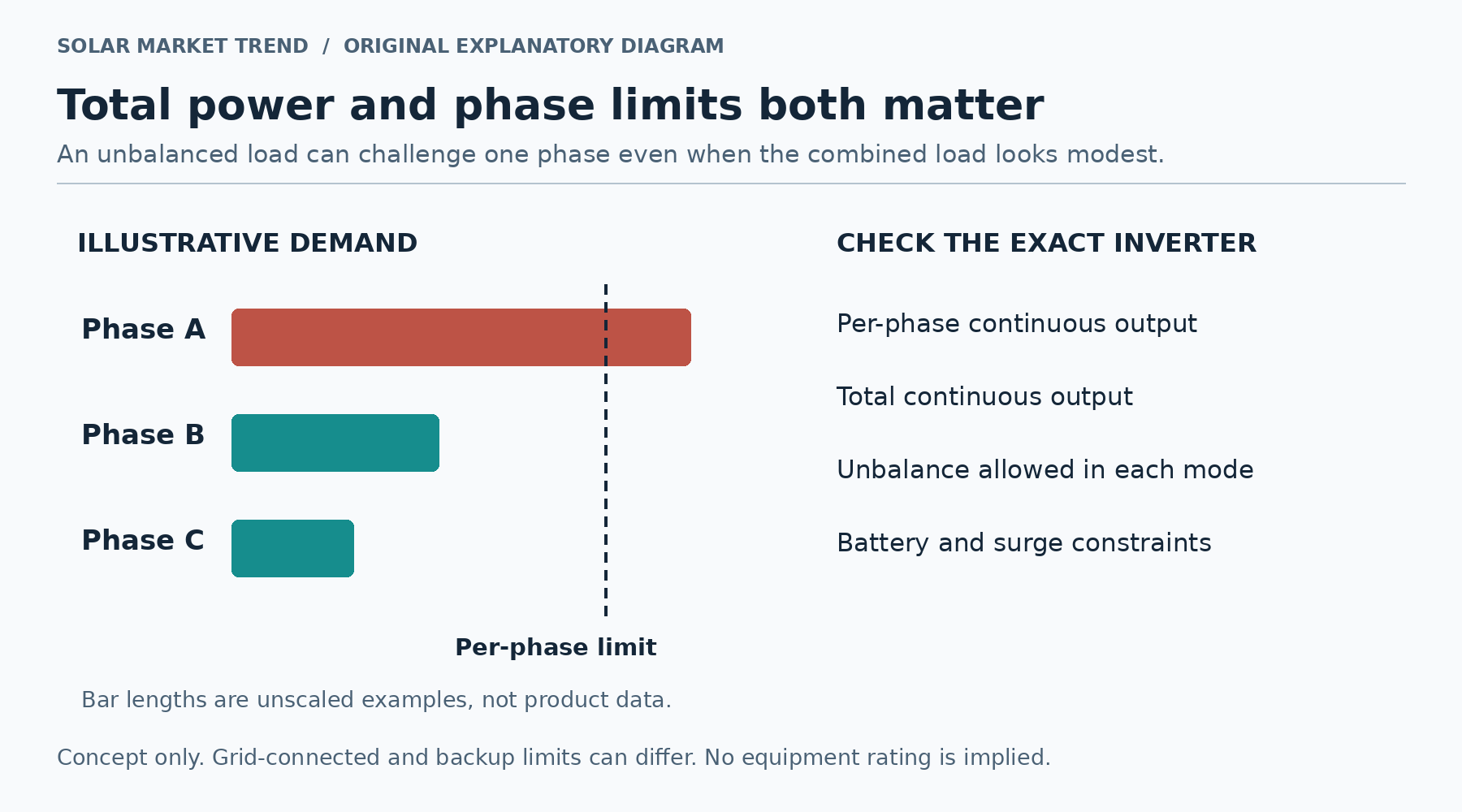
An adequate total can hide a loaded phase
A quotation says the inverter is large enough for the building's total demand. That is only the first check for a three-phase backup system. You also need to know which loads sit on L1, L2 and L3, and how much each phase can supply during an outage.
A three-phase building may contain many single-phase appliances as well as genuine three-phase equipment. Their demand need not be equal. GoodWe's technical explanation of phase-level supply identifies that uneven consumption as the reason independently controlled phase output can be useful. [1]
For a buyer in Pakistan, the practical request is a phase-by-phase backup load schedule. A list containing only total watts, battery capacity and panel count cannot show whether the proposed backup arrangement suits the building.
Do not translate an imbalance percentage without its definition
Manufacturers do not necessarily express unbalanced-output capability on the same basis. Deye's current SUN-(3-12)K-SG05LP3-EU-SM2 product page pairs a 100% unbalanced-output claim with a separate limit of up to 50% of rated power on each phase. It does not say that the inverter's full total rating is available on every phase simultaneously. [2]
GoodWe's current ET LV datasheet uses a headline of up to 150% unbalanced output. Its older ET technical note, version 05 dated August 2020, described 100% phase-level output with an on-grid range up to one third of nominal inverter power per phase. The older note is not a specification for today's ET LV range. [1][3]
These examples are not a brand ranking. They show why the seller should translate a percentage into exact watts or volt-amperes, current, duration and operating mode for the supplied model. Ask what the percentage is measured against.
Use a simple example to expose the missing check
Consider a hypothetical inverter with a 12 kW total continuous limit and a separate 4 kW continuous limit on each phase. Imagine loads of 5 kW on L1, 2 kW on L2 and 1 kW on L3. The total is only 8 kW, but L1 exceeds the assumed phase limit. Unused capacity on the other phases does not prove that this hypothetical unit can supply it.
Now imagine a different hypothetical inverter permitting 6 kW on a phase while retaining the 12 kW total limit. The same load distribution passes those two power checks, but it is not a complete design approval. Current, apparent power, load behaviour and available battery or PV supply still need assessment.
These invented examples explain the comparison method. They are not specifications for Deye, GoodWe or any other product, and they do not recommend rearranging circuits yourself.
Separate grid compensation from outage capability
A system may reduce the sum of imported power across three phases while the utility grid is present. That does not establish what one phase can supply when the grid disappears. Victron's ESS manual distinguishes total-of-all-phases regulation from individual-phase regulation. Its grid-connected examples include import on one phase offset by export on others. [4]
Our inference is straightforward: a dashboard showing a small net grid total is not a backup-capacity test. Ask for islanded operation to be assessed separately from grid-connected energy balancing. This article does not assume that any Pakistani utility meter or tariff nets phases in a particular way.
Read the correct specification rows. GoodWe's ET LV datasheet lists on-grid, backup and generator data separately; it also distinguishes backup output with grid available from its ordinary backup ratings. A large passthrough allowance should not be presented as battery-powered inverter output. [3]
Three backed up circuits are not necessarily three phase power
Supplying single-phase circuits distributed around a three-phase building is different from producing the phase relationship required by a three-phase load. Do not assume that a single-phase backup arrangement becomes a true three-phase supply because several circuits remain live.
SMA's backup-planning guidance explicitly distinguishes phase-coupled single-phase backup from a true three-phase backup grid. It warns that only single-phase loads belong on the described phase-coupled arrangement and that three-phase loads can be damaged. [5]
Ask the designer to identify genuine three-phase equipment in the proposed backup list. Its voltage, phase sequence and supply requirements need to match the actual backup architecture. This is a professional design decision, not a suggestion to bridge phases or alter the neutral arrangement.
Request evidence for each important operating condition
Our recommended load schedule records the circuit, phase, normal demand, important operating changes, whether it is backed up, and any operating restriction agreed with the owner. Ask for a separate statement of the total continuous limit and the continuous limit on each phase. If a higher temporary limit is quoted, its duration must appear beside it.
Then ask which limits apply when the grid is absent, the battery is near its allowed reserve, or available solar power is low. The inverter's conversion capability and the available energy source are separate parts of the assessment. A larger battery energy label alone does not establish greater per-phase output.
Commissioning should check the agreed operating cases and record the result. Solis' installation guidance also explains why phase identity and associated metering must be verified: incorrect matching can produce incorrect control behaviour. That check belongs with qualified personnel. [6]
Compare the delivered function not the largest badge
A useful proposal makes the boundaries visible. It names the exact inverter and firmware, lists backed-up circuits by phase, gives mode-specific limits and identifies loads that must remain off during backup. It also states which assumptions have not yet been verified on site.
If one phase is the constraint, ask the designer to evaluate an appropriate circuit distribution or different system architecture before approving extra equipment. Simply buying more headline kilowatts may leave the original problem unresolved.
The cited examples explain documentation, not current Pakistan prices, stock or a best-inverter ranking. The strongest buying evidence is a clearly defined operating requirement matched to the exact equipment documents and a recorded test of the installed system.
Sources and references
- [1] GoodWe Unbalanced Power Supply Solution
Version 05 updated 18 August 2020 · Checked 2026-10-22
Uneven single-phase demand in three-phase homes; historical definition of on-grid 100% unbalanced output up to one third nominal inverter power per phase.
Historical ET-series technical explanation, explicitly not a specification for the newer ET LV series or a current product comparison.
- [2] Deye SUN-3/4/5/6/8/10/12K-SG05LP3-EU-SM2 Product Page
Current official product page; date not stated · Checked 2026-10-22
100% unbalanced output wording together with up to 50% rated-power limit per phase.
Manufacturer product claim; exact continuous limits and operating conditions must be confirmed against the supplied model's manual and regional configuration. No independent performance test or Pakistan stock claim.
- [3] GoodWe ET LV Series 5 to 20 kW Datasheet
GoodWe-Single page-20260909-EN-V2.1, dated 9 September 2026 · Checked 2026-10-22
Up to 150% unbalanced-output headline; separate on-grid, backup, backup-with-grid and generator specification categories.
Manufacturer datasheet retrieved through the official ET LV product page. Headline 150% is not converted to a model limit here because the relevant basis must be confirmed in full model instructions.
- [4] Victron ESS Design and Installation Manual Multiphase Regulation
Current online manual section 7; date not stated · Checked 2026-10-22
Total-phase versus individual-phase regulation; grid-present import on one phase may coexist with export on others.
Victron-specific grid-connected regulation example, not evidence of Pakistan utility billing or any other brand's islanded output capability.
- [5] SMA Home Energy Solution with Battery Backup Function Utility Grid
Current online planning guide; page date not stated · Checked 2026-10-22
Phase-coupled single-phase backup is not a rotating three-phase supply; warning against three-phase loads in that arrangement.
Specific SMA backup architectures; not general wiring permission. Combined paraphrase of this source across both inverter articles remains under 200 words.
- [6] Solis Installation Guide Phase Sequence and CT Clamp Verification
Modified 1 October 2026; technical update September 2026 · Checked 2026-10-22
Incorrect phase or CT correspondence can cause incorrect energy-control behaviour.
Manufacturer installation guidance, cited only for the need to verify phase and meter correspondence; no commissioning steps reproduced. Shared source with generator article.