AI & SOLAR EVIDENCE
Use of AI in Solar What Pakistani Buyers Can Use and What Still Needs Proof
Share on social media

AI can help forecast solar output, find unusual performance and prioritise maintenance. The useful question is whether it improves a defined decision using trustworthy local data.
Artificial intelligence can be useful in solar, but an AI label is not an extra source of electricity. Its value comes from turning measurements into better decisions: estimating tomorrow's generation, identifying a system that needs attention, or helping an operator investigate a fault. Pakistani households and businesses should ask what decision the software improves before paying for the label.
The evidence is developing. IEA PVPS's February 2026 report describes digital twins as representations of photovoltaic systems updated with real-world information. It distinguishes physics-based and data-driven approaches and emphasises interoperable data and cybersecurity. That is a more useful starting point than treating every monitoring screen as an intelligent controller. [1]
Forecasting can support planning without promising sunshine
A generation forecast can help a business consider when to run flexible loads or how much battery reserve to retain. It should carry uncertainty, not present a single number as a guaranteed energy budget. Decisions must still respect equipment limits, operating requirements and the site's electricity arrangements.
SolarSeer, a research preprint revised in September 2025, demonstrates AI-based day-ahead irradiance forecasting using historical satellite observations. Its evaluation concerns the contiguous United States. It is evidence of a forecasting approach, not proof of the same performance in Lahore, Karachi or a shaded rooftop. Irradiance prediction is also not identical to forecasting the AC output of a particular installation. [2]
A more recent paper, revised on 8 September 2026 and accepted for the UK AI Conference, studied a UK charging-station PV site. Its results depended on the evaluation method and the weather information available to the model. Improvements under a rolling-origin test were much smaller than under random day-fold evaluation, and one improvement was not robust across days. The practical lesson is to ask whether a claimed forecast was tested using information genuinely available before the forecast period, rather than retrospectively supplied weather. [3]
Fault detection should lead to a checked maintenance action
Unusual output does not immediately identify a failed panel. Monitoring needs context. IEA PVPS's review of advanced failure-monitoring methods describes comparisons with historical operation, predicted performance, electrical signatures and other systems or subsystems. Machine learning is one approach alongside statistical tests, rules and simulation. Available data also differ by device and monitoring architecture. [4]
For a Pakistani factory, a useful service might flag an inverter whose production departs from comparable equipment and assemble the evidence for an engineer. A household service might explain why an alert warrants an installer visit. These are proposed uses, not claims that a particular commercial app already performs them reliably. An alert should include its time window, relevant measurements and confidence or uncertainty, rather than simply displaying an alarming colour.
There is a real research foundation behind such applications. The US Department of Energy's SETO 2020 programme funded work on anomaly classification, predictive maintenance, net-load forecasting and grid visibility. Those programme descriptions establish research aims; they should not be repackaged as independently verified savings achieved by every AI product sold today. [5]
Better data usually comes before a better model
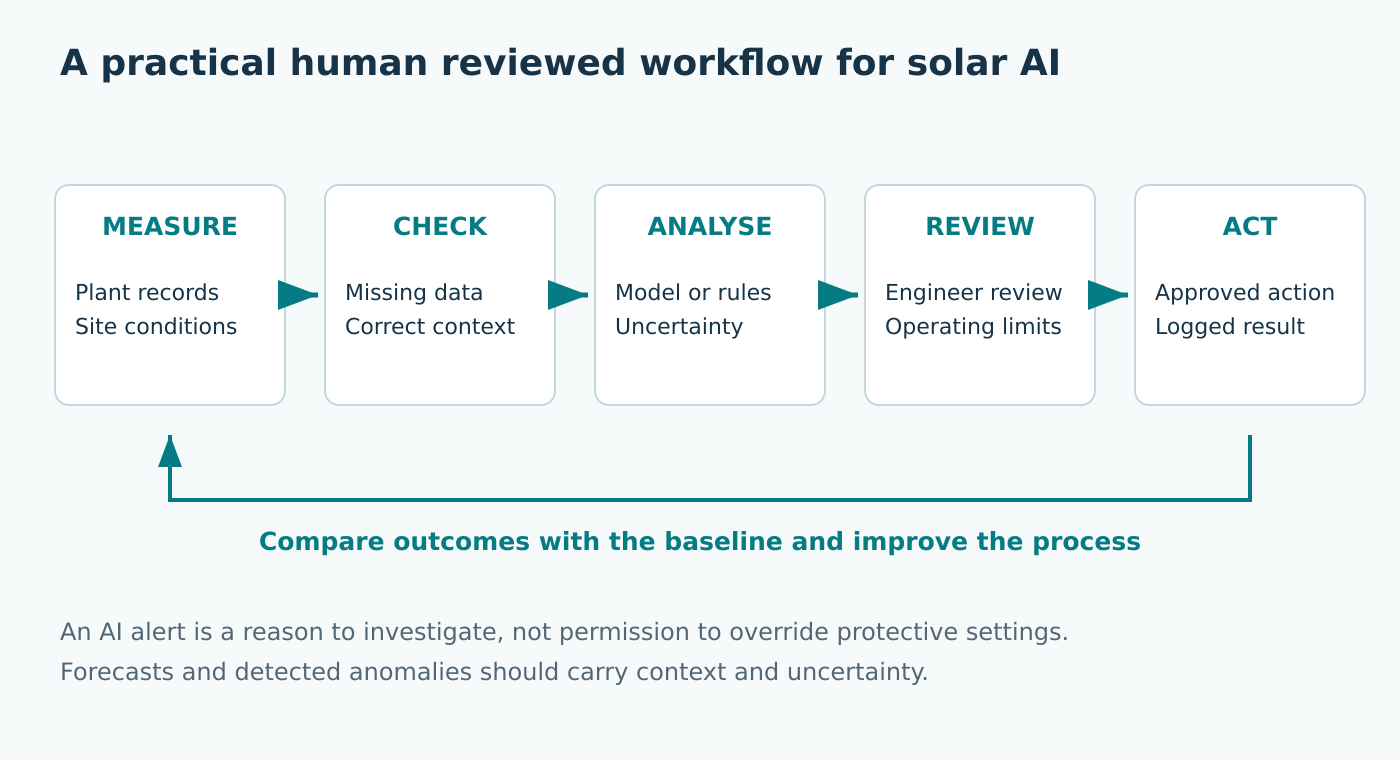
Before evaluating software, establish what the installation actually records. Are timestamps consistent? Are missing readings marked rather than replaced with unexplained zeros? Did the array, meter location or inverter configuration change? Is the comparison period representative of the current system?
A provider should explain how it distinguishes loss of communications from loss of generation, and how corrected equipment records reach the model. The 2026 IEA PVPS report's emphasis on structured data and interoperable systems matters here: a sophisticated algorithm cannot make ambiguous plant records trustworthy by itself. [1]
Separate advice from permission to control equipment
A tool that summarises a manual is different from one that changes battery settings or dispatches equipment. Ask who approves actions, what operating limits cannot be overridden, what happens if communications fail, and how changes are logged and reversed. Do not let an unverified chatbot select protection settings or substitute for a qualified electrical professional.
NIST's AI Risk Management Framework calls for testing before deployment and regularly during operation, using suitable benchmarks and documenting uncertainty. Its current website notes that the 2023 framework is being updated; this is guidance for evaluating risk, not a Pakistan solar certification or a guarantee that a vendor complies. [6]
Ask for a small auditable trial
Define one outcome before buying: earlier verified fault discovery, fewer unnecessary site visits, or a forecast that improves an agreed operational decision. Ask for the baseline, evaluation period, false-alert record, data ownership and export arrangements, ongoing cost, and human response process. Compare like-for-like site conditions, not a selected screenshot from another country.
The best use of AI in solar is practical and accountable. Start with reliable measurements and a clear operating problem, then test whether the proposed tool adds value. Keep engineering judgement, safety controls and evidence ahead of the marketing label.
Sources and references
- [1] IEA PVPS Digitalisation and Digital Twins in Photovoltaic Systems
Technical overview; digital twins, data interoperability and cybersecurity.
Source date: February 2026. Verified: 2026-10-17.
- [2] SolarSeer research preprint version 2
Author research on contiguous US irradiance forecasting; not Pakistan validation.
Source date: 2 September 2025. Verified: 2026-10-17.
- [3] An AI-Based Decision-Support Pipeline for Day-Ahead Photovoltaic Forecasting version 2
UK site research; accepted UK AI Conference paper; evaluation and weather-input limitations.
Source date: 8 September 2026. Verified: 2026-10-17.
- [4] IEA PVPS The Use of Advanced Algorithms in PV Failure Monitoring executive summary
Methods and data sources for statistical PV fault monitoring, not a current product test.
Source date: September 2021. Verified: 2026-10-17.
- [5] US DOE SETO 2020 Artificial Intelligence Applications in Solar Energy
Historical research programme objectives, not delivered commercial performance.
Source date: Programme announced 5 February 2020; additional selection 18 November 2021. Verified: 2026-10-17.
- [6] NIST AI Risk Management Framework Core
Voluntary general AI risk framework; current page says revision is in progress.
Source date: AI RMF 1.0, 2023; live page checked 17 October 2026. Verified: 2026-10-17.