SOLAR INVERTER BUYER GUIDE
Zero Export Solar: Why the Meter and CT Installation Matter
Share on social media
A practical guide to the measurement and control chain behind zero export, covering CT location, direction, phase matching, ratios, response time and failure testing without confusing a setting with connection approval.
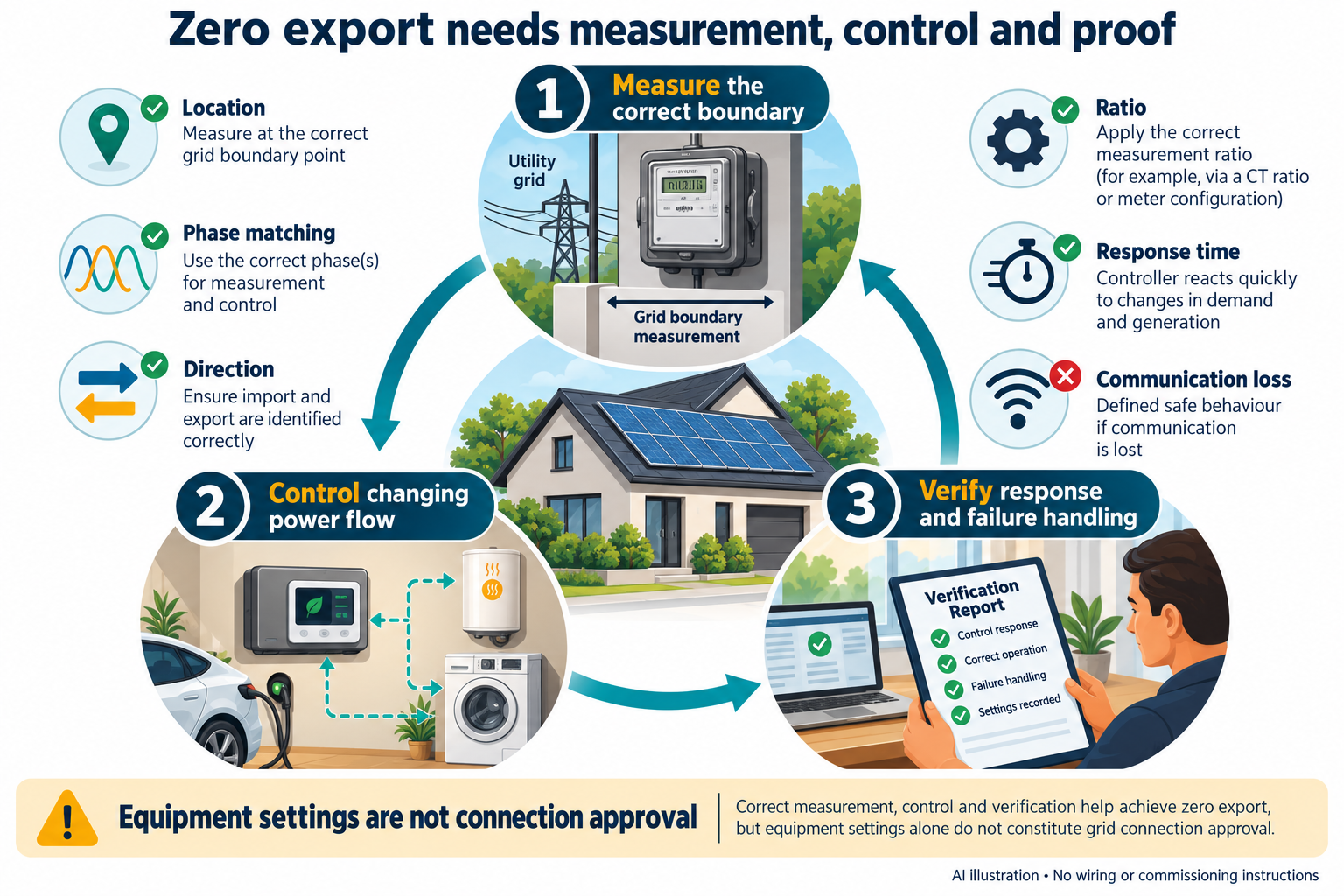
Original companion diagram
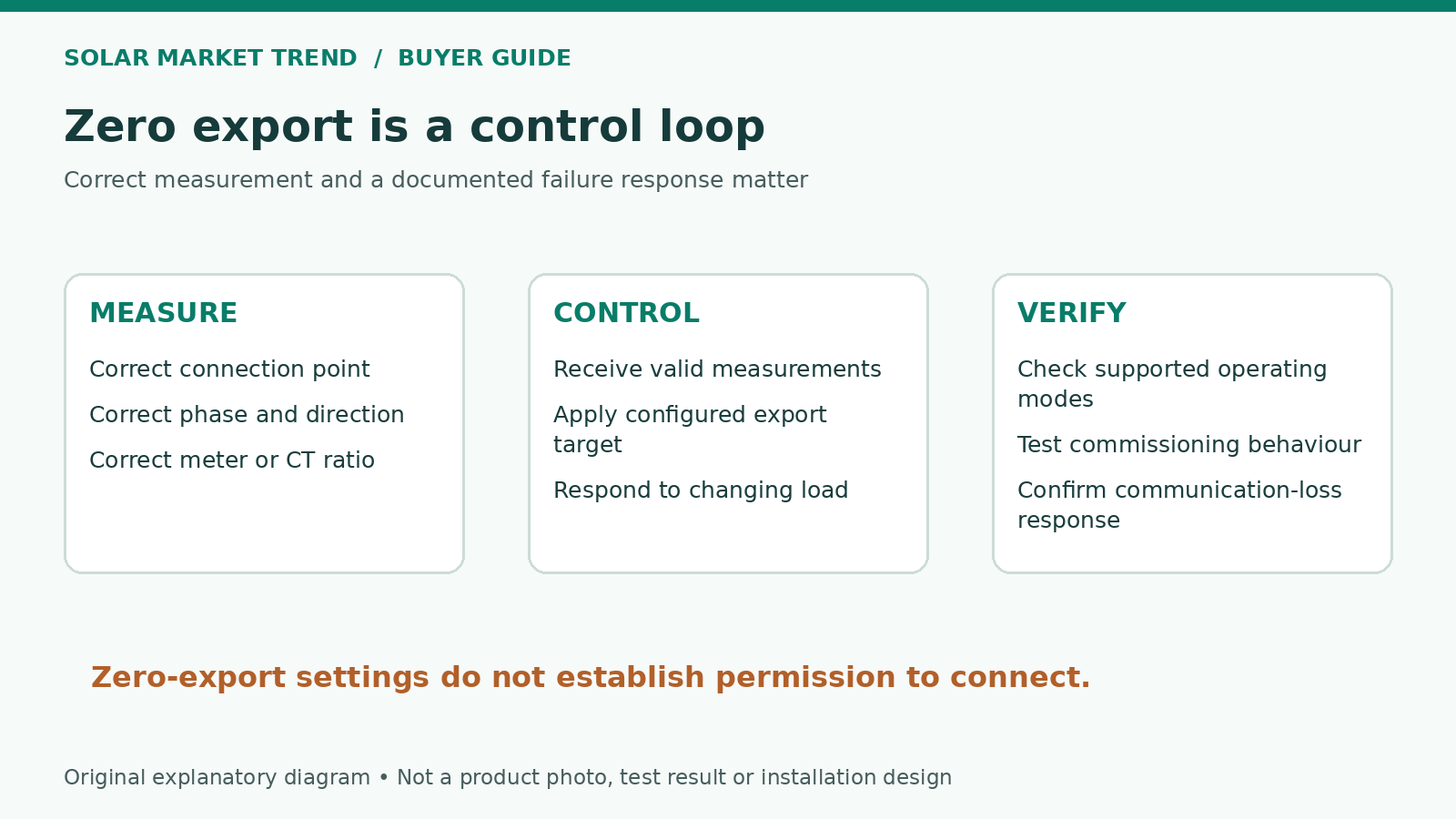
Zero export is a control loop, not a label
For a home or business in Pakistan, a zero-export setting is only the beginning of a technical question: how does the system know whether power is crossing the grid connection? SMA’s planning guidance describes a grid-connected arrangement in which controllable generation is adjusted to local consumption. It requires compatible measuring and control equipment, not simply a fixed inverter power setting. [1]
When demand falls, the system may reduce solar output; a storage system may also adjust battery charging or discharging. Sungrow documents these as distinct control responses. A low solar-production reading can therefore be intentional when usable demand is low. Zero export does not mean every available unit of sunshine must become electricity. [2]
Measure the boundary you actually want to control
A current transformer, usually called a CT, measures current through a conductor. Its location determines what the controller sees. Solis specifically warns that placing its EPM sensing on a load branch instead of the correct grid measurement location can produce abnormal control. Measuring one air-conditioner circuit cannot automatically describe the whole building’s exchange with the grid. [3]
Ask for a diagram identifying the grid connection, solar inverter branches, loads, meter and CTs. Any additional inverter matters. Solis’ direct-CT guide applies to supported single-phase units with a CT port and a single-inverter system; it directs multi-inverter systems to its EPM solution. A convenient socket or similar-looking accessory is not proof of compatibility. [4]
Four CT checks prevent misleading readings
First, confirm direction against the exact CT and meter documentation. Do not apply an arrow rule remembered from another brand. Second, match each current measurement to its corresponding voltage phase. Fronius explicitly requires L1 current and L1 voltage to describe the same phase, with equivalent matching on the others. Reversed direction or swapped wiring can change the sign of the measured power. [5]
Third, verify the actual CT ratio and the configured ratio. Fourth, match the CT output type to the receiving device. The Fronius Smart Meter 50kA-3 manual specifies current-output CTs, while Solis’ 5G EPM documentation specifies a 5 A secondary. Those examples are not universal requirements for every smart meter or direct-CT input. Record the part numbers and settings rather than accepting ‘standard CT’ as the specification. [3][5]
Three-phase totals can conceal a different result
Imagine one phase exporting 1 kW while another imports 1 kW and the third is balanced. The arithmetic total is zero, but one conductor is still exporting. This is an illustrative power balance, not a measurement from a Pakistani installation. It explains why aggregate and per-phase control are different questions.
Sungrow’s cited controller documentation distinguishes total active-power control from per-phase control. SMA’s phase-exact zero-export guidance says it reduces total feed-in power when export occurs on an individual conductor, potentially increasing grid imports. Ask which approach the proposed system supports and which your connection requires; neither should be assumed from a three-phase label alone. [2][6]
‘Zero’ needs a response-time definition
A changing load creates a measurement-and-control problem, not a permanently fixed balance. SMA describes one Data Manager M solution as achieving zero export within two seconds with a meter providing 200-millisecond samples. That is a documented system condition, not a guaranteed response for every inverter bearing a zero-export option. [7]
Ask the installer how performance will be verified when a substantial load switches off. Request the measurement interval, response behaviour and any manufacturer-supported import margin. A screenshot showing zero at one instant does not answer what happened between samples. This is an acceptance-test recommendation, not an assertion that transient export is permitted at your connection.
Accept evidence of failure handling
Solis’ EPM commissioning guide includes CT verification and tests of communication failure, individual-inverter communication loss and limiting operation. The important purchasing lesson is to demand an equipment-specific failure response and a documented test, rather than assuming a lost meter signal will always produce a safe outcome. These tests belong to qualified personnel following the applicable manual; do not disconnect CT wiring yourself. [8]
Your handover pack should contain the sensing diagram, meter and CT models, configured ratios, phase checks, export target, controller coverage and commissioning results. Finally, keep equipment capability separate from permission: the international manufacturer documents cited here do not establish a Pakistani utility’s connection approval, billing treatment or protection requirements. Confirm those independently. A zero-export setting is not evidence that those separate questions have been resolved.
Sources and references
- [1] SMA: Planning Guidelines, PV Systems with Zero Export
- [2] Sungrow: Zero Export controller documentation
- [3] Solis Seminar Episode 26: Export Power Manager frequently asked questions
- [4] Solis Seminar Episode 76: Export Power Management and Load Monitoring by CT
- [5] Fronius Smart Meter 50kA-3: Operating instructions
- [6] SMA Data Manager M: Setting Zero Export
- [7] SMA commercial-system planning: Zero export
- [8] Solis: EPM Configuration and Validation Guide, updated 25 August 2026