BATTERY AND INVERTER COMPATIBILITY
Solar Battery and Inverter Compatibility Beyond Matching Voltage
Share on social media
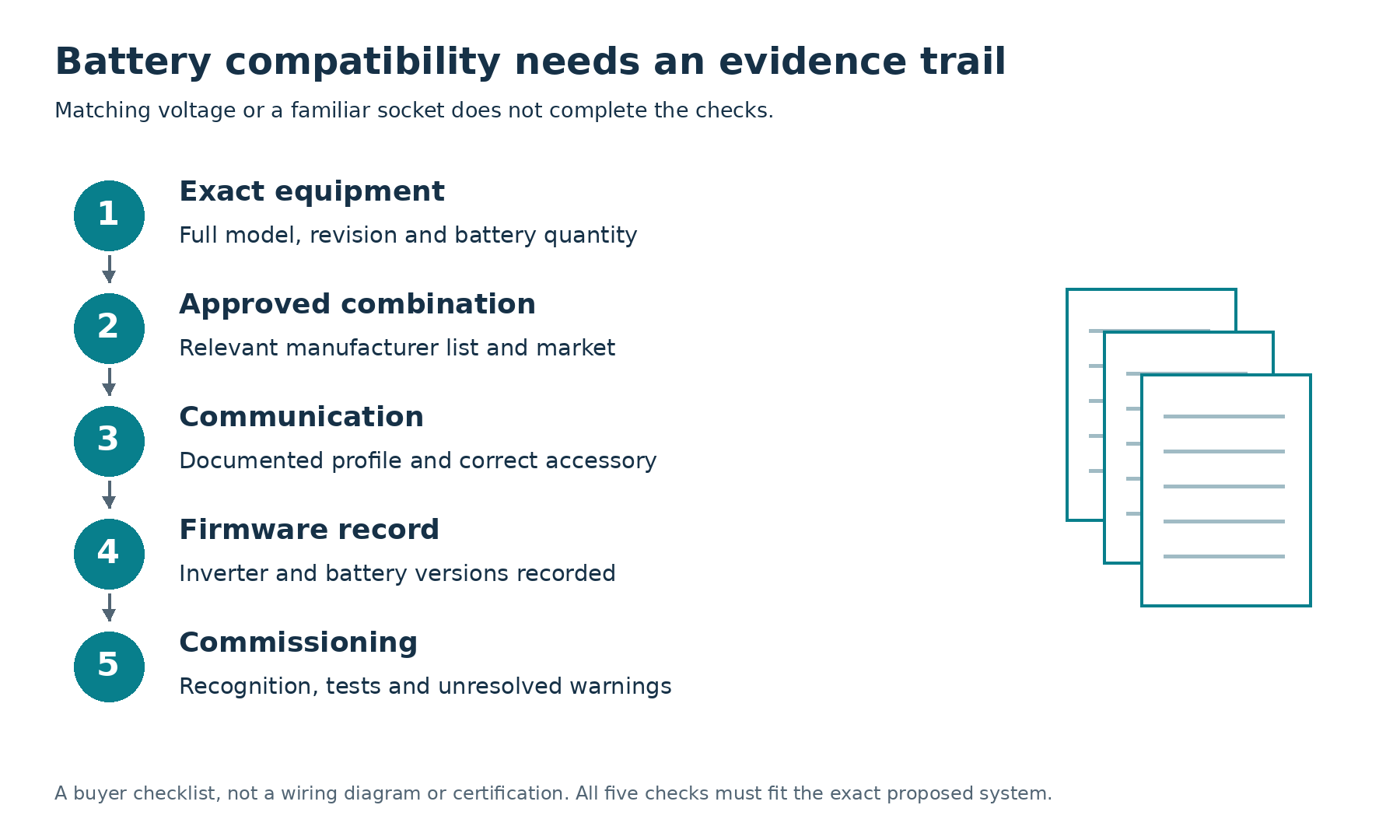
Before accepting a solar quotation in Pakistan, ask the installer to identify the exact battery and inverter combination in manufacturer documentation. A matching voltage label, familiar brand name or working display is not enough evidence for a complete purchase decision.
This guide focuses on communication, approved configurations and handover records. It does not compare battery chemistry, estimate backup hours or recommend a particular brand. The aim is to help buyers distinguish a documented system from a pairing supported only by a sales assurance.
Start with the exact equipment
Request the full inverter model code, battery model, hardware revision where relevant, and proposed module quantity. Keep these identifiers in the quotation rather than accepting descriptions such as “6kW hybrid” and “5kWh lithium.”
Victron’s Pylontech integration guide illustrates why revisions matter. It identifies UP2500NA01V00101 as unsupported because it lacks a CAN-bus port, while UP2500NB01V00101 is supported. The same guide requires a GX device for the documented integration and specifies minimum firmware for new installations. A product-family name therefore does not settle the question. [1]
The practical buyer’s question is: “Can you show me the row and accompanying notes that cover the equipment you will actually supply?”
CAN and RS485 need a documented match
CAN and RS485 labels should prompt further checking, not end it. GoodWe’s compatibility overview says only listed batteries are approved for connection under its limited warranty. It separately directs buyers of unlisted batteries following the GoodWe CAN protocol to its technical service for matching information. Protocol claims and published approval are therefore distinct checks. [2]
Deye’s low-voltage list names covered inverter models, battery models, communication interfaces and setup entries, and asks purchasers to confirm compatibility with the battery supplier. “Supports CAN” leaves several fields unanswered. [3] Its separate CAN and RS485 entries reinforce the need to use the documented communication route for the proposed combination. [3]
In the documented Victron–Pylontech arrangement, communication carries state of charge, charge/discharge limits, error codes and a keep-alive signal. These operational inputs cannot be established from a nominal voltage label. [1]
Ask the installer to document the required communication profile and manufacturer-specified cable or accessory. Do not improvise a connection because two sockets look alike. Victron specifies different communication cables for different Pylontech models. [1]
Read an approved combination narrowly
For a concrete example, Deye’s list DY-LV48-0126 covers SUN-6K-SG03LP1-EU within its stated inverter range and includes Pylontech US5000 in its CAN battery entries. That is evidence for a named pairing within that document’s scope, not approval for every Deye inverter or every Pylontech battery. [3]
A second example shows why battery quantity matters. BYD’s HVS/HVM list V2.22 specifies two to five HVS modules or four to eight HVM modules for GoodWe ET (15–30kW). It also records inverter and battery firmware requirements, rather than treating the brand pairing as a single unconditional approval. [4]
These are examples of how to read evidence, not shopping recommendations or complete installation designs. Before ordering either example, the installer must still check the exact product variant, current documents and conditions applicable to the proposed system.
Put firmware in the quotation
“Firmware updated” is a weak handover record. Ask for the actual versions installed, along with the versions required by the applicable compatibility documents.
GoodWe’s September 2026 overview specifically says BYD HVM 11.0 used with ET 15–30kW inverters requires ARM 09/DSP 08 or above. [2] BYD’s October 2026 list specifies ARM 09 and DSP 08 for that ET range, plus minimum battery BMU 3.20 and BMS 3.27. It also instructs use of the latest Battery-Box firmware. Minimum listed versions should not be mistaken for a recommendation to install old software. [4]
Record inverter firmware and battery firmware separately. If the two manufacturers’ instructions appear inconsistent, ask for written technical clarification before installation rather than assuming the less restrictive statement wins. That is a purchasing safeguard, not a substitute for the manufacturer’s commissioning procedure.
Check the market and expansion plan
A global compatibility document is not automatically a Pakistan-specific guarantee. Solis’s GLOBAL-V3.6 battery matching list explicitly says compatibility can vary between markets and directs readers to the relevant country or market technical team for confirmation. It also separates inverter groups and battery-selection options. [5]
For a Pakistan quotation, request confirmation that the supplied regional variant and proposed battery are covered locally. Keep the response with the invoice and warranty documents. If a seller relies on an overseas screenshot, ask for the complete source and relevant market conditions.
Treat a future battery expansion as a fresh compatibility check. BYD’s list includes parallel-connection restrictions, including equal module counts between parallel towers and no mixing of HVS with HVM systems. An approved initial installation does not make every later expansion acceptable. [4]
Ask for evidence at commissioning
BYD’s HVS/HVM service checklist records battery configuration, inverter identification, commissioning date, BMU firmware, BMS firmware and inverter firmware. Its general checks include correct battery state-of-charge display and actual charging and discharging. These are useful examples of what documented handover evidence looks like. [6]
For your own system, ask the qualified installer to provide:
- The applicable compatibility documents and their versions.
- Equipment identifiers matching the quotation and installed labels.
- Screenshots of installed firmware and successful battery recognition.
- A completed commissioning record, including any unresolved warnings.
- Written support contacts and the agreed route for reporting faults.
Where backup operation is part of the purchase, ask the installer to demonstrate the agreed operating scenario safely and record any limitations. Keep the results rather than relying on a brief demonstration described only as “working.”
Electrical installation, live testing and firmware-dependent commissioning should be handled by qualified professionals. BYD expressly restricts work and measurements on its Battery-Box system to professional, qualified electricians. This article provides no wiring instructions. [6]
The purchase decision
Choose a combination the supplier can document and commission, not merely one it says should communicate. If the approved configuration, firmware evidence or local support position remains unclear, resolve that gap before accepting the installation.
Sources were checked on 16 October 2026. Manufacturer lists can change. The examples establish what the cited documents say, not Pakistan stock availability, an individual warranty entitlement or performance of an untested installation.
Sources
- [1] Victron and Pylontech battery integration guide
Live guide; no fixed publication date relied upon. Specific to the Pylontech models and Victron system architecture covered by this guide. Does not establish compatibility with other manufacturers.
- [2] GoodWe Battery Compatibility Overview
2026-09-10. Live PDF URL may be replaced. Opened PDF is dated September 10, 2026. Requirements vary by system family and row.
- [3] Deye Approved Battery List
2026-05-27. Official dated low-voltage list. No claim that it is the newest Deye release, a complete design or a Pakistan warranty determination.
- [4] BYD Battery-Box Premium HVS and HVM Compatible Inverter List
2026-10-10. Applies to the specified HVS/HVM families and configurations. Do not transfer requirements to HVS+/HVM+, other control-unit generations or unrelated battery families.
- [5] Solis Energy Storage Inverters Battery Matching Compatibility List
Date not stated. No publication date asserted. The document explicitly says compatibility varies across markets; no Pakistan-specific model approval is inferred.
- [6] BYD Battery-Box Premium HVS/HVM Service Guideline and Checklist
2022-01-11. Older family-specific checklist still linked on BYD's download page. Used only for evidence fields and professional-work requirements, not as a current universal installation procedure.