SOLAR SURGE PROTECTION
Solar SPD Labels in Pakistan Understanding Ratings and Breaker Coordination
Share on social media
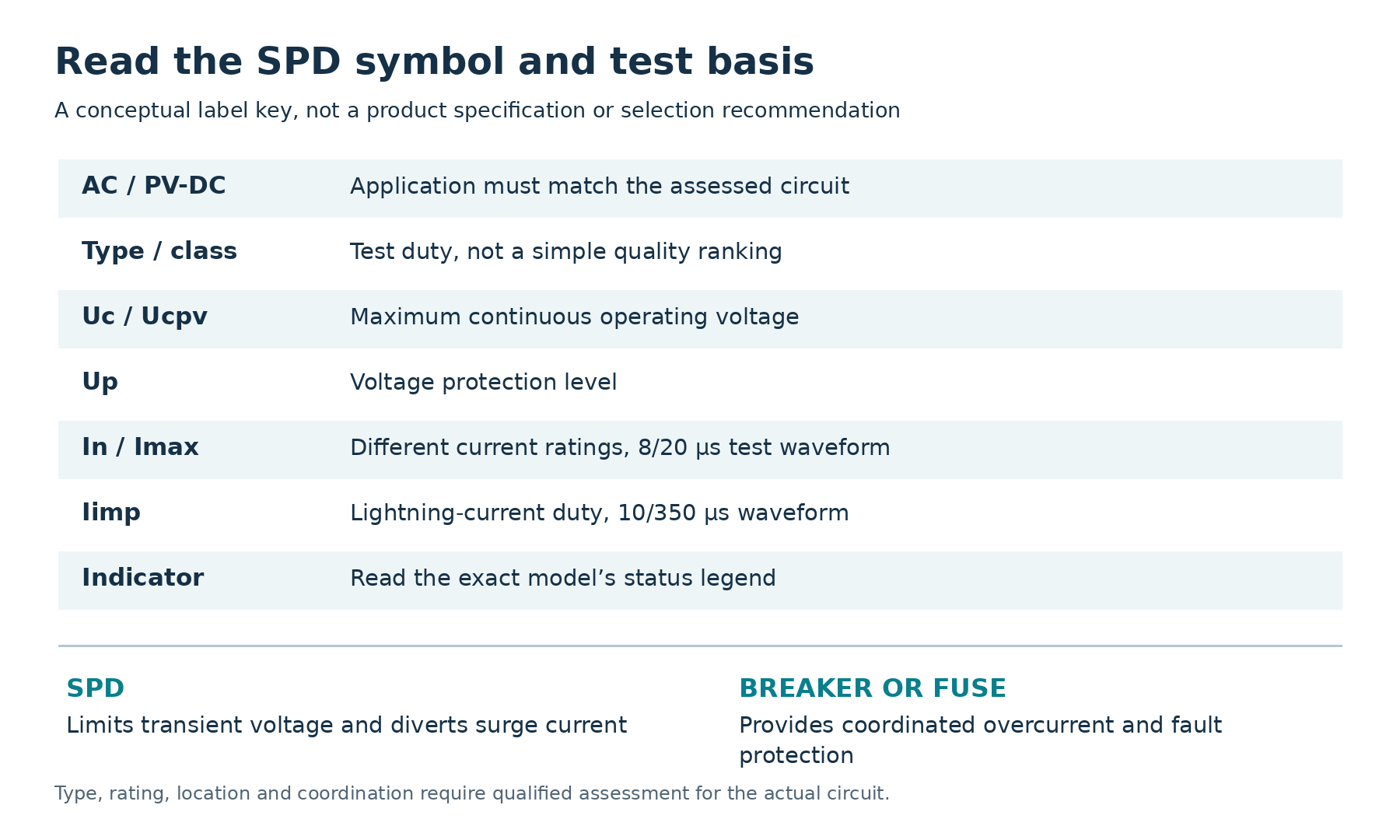
Solar SPD labels can look reassuring without being understood. For buyers in Pakistan, figures such as Ucpv, Up and Imax are useful only when the installer explains what they mean and why the proposed device suits the actual circuit.
This guide helps you read that specification and ask better questions. It is not a wiring tutorial. Final selection requires a qualified solar electrical designer's assessment of the building, installation and lightning exposure.
An SPD and a breaker perform different jobs
An SPD limits brief transient overvoltages and diverts surge current through its protective paths. Conventional circuit-breaker or fuse protection deals with overcurrent and faults. A proposal therefore needs both functions where the design requires them; buying a larger breaker does not replace surge protection. An SPD's internal disconnector also should not be mistaken for complete circuit protection. [1][5]
Think of these as complementary protections rather than interchangeable accessories. Ask the installer to label each device by function on the quotation. A box containing several similar-looking modules does not demonstrate that all necessary protections are present, or that the modules have been selected to work together.
Keep AC and photovoltaic DC selection separate
The inverter connects two different electrical environments: the photovoltaic DC side and the AC installation. The IEC's public description of IEC 61643-31 specifically addresses SPDs for PV DC applications, including the generator and inverter DC sides. It does not make an ordinary AC SPD suitable for solar strings. Nor should its PV scope be treated as blanket approval for a battery-storage circuit. [2]
Request distinct AC and PV-DC model numbers and datasheets. For the AC device, the designer must account for the supply and earthing arrangement. For the DC device, request evidence that the exact model is intended for photovoltaic service. A similar enclosure, matching brand or prominent voltage number is insufficient evidence of interchangeability. [1][2]
Read the voltage ratings before the headline kA figure
Ucpv identifies the maximum continuous DC voltage permitted across a PV SPD's specified terminals. Selection must consider the PV system's maximum open-circuit voltage under environmental conditions, including temperature, rather than simply copying the inverter's normal operating voltage. DEHN's glossary explicitly links this assessment to environmental influences. Ask the designer to provide the calculation and applicable selection basis. [3]
For AC devices, Uc is the maximum continuous operating voltage. Another rating, Up, describes the voltage protection level. It must be considered against the protected equipment's impulse-withstand capability. Neither figure should be confused with a discharge-current rating. [1][3]
For a Pakistan buyer, the practical request is a documented match between the actual string design, site conditions, inverter requirements and proposed SPD. There is no universal DC voltage rating that this guide can responsibly recommend for every installation.
Compare In Imax and Iimp on the same basis
A bare “kA” number leaves out important information. Read the symbol beside it:
- In is nominal discharge current, associated with an 8/20 microsecond test waveform.
- Imax is maximum discharge current, also associated with an 8/20 microsecond waveform, but it is a different rating from In.
- Iimp is impulse-current capability associated with the 10/350 microsecond lightning-current test. [6]
These are surge-test quantities, not the inverter's everyday operating current. Comparing one product's Imax directly with another's Iimp is misleading because the test duties differ. Ask the supplier to compare the same characteristic, waveform and stated protection path or total. A larger printed number alone does not establish the better choice. [6]
Type 1 Type 2 and location follow the site assessment
SPD types refer to different test duties, not a simple good-better-best ranking. Type 1 addresses lightning-current duty; Type 2 addresses surge duty. Combined devices can fulfil more than one classification, but their label does not eliminate the need for an engineered protection plan. [1]
DEHN's rooftop examples distinguish buildings without external lightning protection from those with it, then consider whether the required separation distance can be maintained. Those scenarios lead to different protective arrangements. Its guidance also considers the distance between the array, inverter and grid connection when deciding whether additional devices are needed. [4]
Ask what assumptions support the proposed type and location on your roof. Do not accept “all solar systems use this type” as the assessment. Conversely, this article does not declare Type 1 mandatory on every Pakistani rooftop, or Type 2 sufficient everywhere. The cited international and manufacturer examples are technical references, not a statement of Pakistan law.
Coordination means checking the entire protection system
Check fault coordination as well as surge ratings. Schneider Electric explains that thermal and short-circuit protection must be coordinated with the SPD, and that the manufacturer should specify the appropriate protective-device association. Depending on the design, the short-circuit protective function may be separate or integrated. Do not assume that whichever breaker is already available is the correct partner. [5]
Also ask what each status indicator means on the supplied model. ABB's examples include end-of-life indications requiring replacement. Obtain the relevant manufacturer's explanation and a qualified maintenance contact; a colour window is not a substitute for assessing the complete installation. [6]
Earthing and equipotential bonding remain part of DEHN's rooftop protection examples. Ask how the specified devices fit that wider design, rather than treating a correctly labelled SPD as proof that the whole installation is protected. [4]
What to ask for before accepting the quotation
Use this short handover checklist:
- Exact AC and PV-DC SPD models, datasheets, classifications and clearly identified current ratings.
- A written explanation of the lightning assessment and the proposed device types and locations.
- The PV voltage-selection calculation, plus the proposed voltage protection level and equipment compatibility.
- The manufacturer's basis for any associated breaker, fuse or integrated fault-protection arrangement.
- A system drawing showing the assessed protection zones, relevant power and signal paths, and the earthing and bonding concept.
- The indicator legend and a maintenance plan identifying who checks and replaces devices when needed.
These are questions for the installer, not instructions to open an electrical enclosure. Ask for the records with the quotation, rather than relying on a verbal promise after installation. Keep the final equipment schedule and commissioning documents together so a future technician can understand what was actually fitted.
The buyers takeaway
Buy a justified protection design, not just an SPD with an impressive label. Clear documentation should explain each device's job, why it suits that circuit and how it fits the wider installation. If the supplier cannot explain those choices, seek a qualified review before approving the equipment.
Sources
- [1] The Surge Protection Device (SPD)
Date not stated. Used for technical principles, not for asserting the latest edition of any cited standard or Pakistan legal requirements.
- [2] IEC 61643-31:2018: Requirements and test methods for SPDs for photovoltaic installations
2018-01-10. Only public catalogue text was inspected. Full paid standard was not purchased or reviewed; no claim about local adoption or an installation approval.
- [3] Blitzplaner glossary: Maximum continuous operating voltage UCPV for a photovoltaic system
Date not stated. The article deliberately does not repeat the page's numerical design factor as a universal rule; the actual product instructions, design basis and site conditions must determine selection.
- [4] Lightning and surge protection for rooftop PV systems
Date not stated. Examples cite international/German standards and do not establish Pakistan law. No universal type, separation distance or device-placement instruction is given.
- [5] Selection of external Short Circuit Protection Device (SCPD)
Date not stated. General coordination explanation only. AC coordination tables are not presented as interchangeable PV-DC installation specifications.
- [6] System pro M compact: Surge and lightning protection solutions, main catalog
2015-05. Older catalogue used only for enduring rating terminology and explicitly attributed indicator examples. No dated model, product availability, current standards edition, numerical device-selection recommendation or performance claim is endorsed.