SOLAR INVERTER GUIDE
IP Ratings in Solar Inverters: What IP21, IP65 and IP66 Really Mean
Share on social media
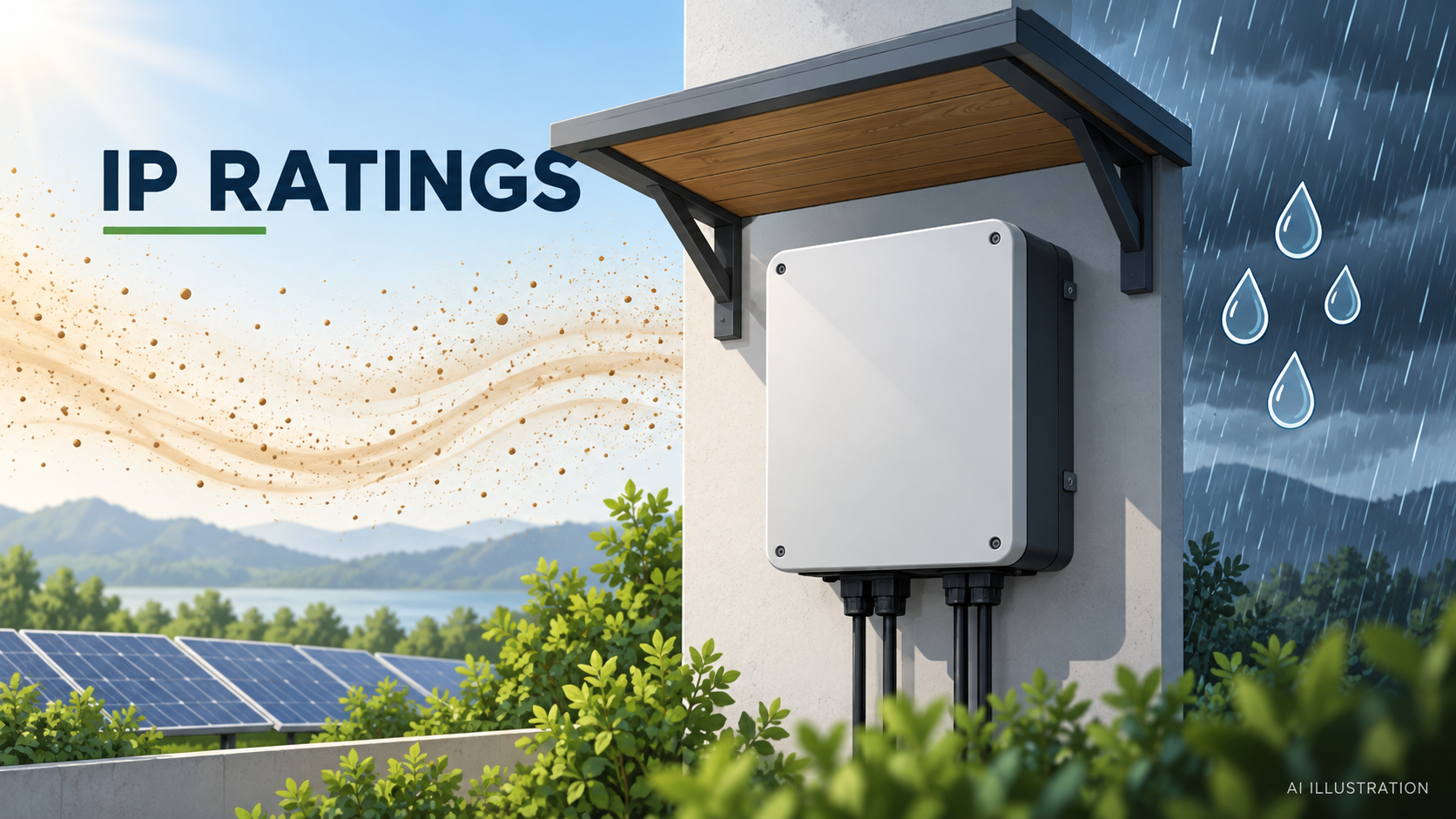
An IP rating describes tested enclosure protection against access, solids and water. It does not replace the inverter installation manual or establish overall quality.
When choosing a solar inverter, buyers often compare capacity, price and warranty first. The installation location deserves the same attention. A sheltered indoor wall and an exposed rooftop create very different conditions for electrical equipment.
The IP rating helps explain the protection provided by an enclosure. It is useful when assessing dust and water exposure, but it should be read alongside the exact model’s installation instructions, not treated as a promise that an inverter can survive anywhere.
What does an IP rating mean?
The IP Code is defined by IEC 60529, the standard for degrees of protection provided by electrical enclosures. The familiar two-digit code describes different kinds of protection. It is an enclosure classification, not an efficiency rating or an independent assessment of every component inside the inverter. IEC 60529
The first digit concerns access to hazardous parts and solid foreign objects. The second concerns harmful ingress of water under specified test conditions. Read the digits separately: IP65 should not be understood simply as a score of “65 out of 100.”
IP21, IP65 and IP66 explained
- IP21: The first digit relates to protection against solid objects of 12.5 mm or larger and finger access under the prescribed test. The second indicates protection against vertically falling water drops. It is not a dust-tight or rain-exposure rating.
- IP65: The enclosure is dust-tight and protected against water jets under the specified test conditions.
- IP66: The enclosure is dust-tight and protected against more powerful water jets under the specified test conditions.
These descriptions follow the IP classification explained in Rittal’s enclosure guide. Schneider Electric also explains the “6” and “5” in IP65 as dust-tightness and water-jet protection. Schneider Electric IP65 explanation
Does IP65 mean waterproof?
Avoid using “waterproof” without qualification. Water-jet protection does not establish suitability for immersion, flooding, pressure washing or every long-term outdoor condition. The installation manual remains the deciding document for permitted exposure and positioning.
An IP label alone also does not establish resistance to corrosion, ultraviolet exposure or mechanical impact. Outdoor enclosure selection needs an assessment of the actual environment, not just the largest number on a specification sheet. Rittal outdoor enclosure guidance
For a buyer in Pakistan, this means describing the site accurately: Is it a dry indoor room, a sheltered veranda, an industrial workshop or a roof exposed to weather? Ask the installer to select the equipment for that setting rather than assuming one rating suits every location.
Why a high IP rating does not solve overheating
An inverter still needs to release heat. Placing it in direct sunlight, squeezing it into a small cupboard or blocking its cooling path can undermine an otherwise sensible installation.
SMA’s installation guidance calls for attention to heat dissipation and avoiding direct solar irradiation. Clearances and mounting arrangements are model-specific, so copy them from the selected inverter’s manual rather than from another brand’s installation. SMA installation site and heat dissipation
A shade or canopy may be helpful where the manufacturer permits it, but it should not obstruct airflow or access. Do not add a sealed outer box as an improvised weatherproofing solution without an engineered thermal and electrical assessment.
Installation details can affect the protection
The condition of cable entries, connectors, covers and seals matters. A rating applies to the specified assembled configuration, not an inverter with missing caps or an open connection compartment.
For example, SMA’s mounting instructions explain that the connection area must remain dry during installation and that the stated protection depends on correctly fitted connectors and protective caps. This is a useful illustration, not a substitute for your own model’s instructions. SMA mounting requirements
Have a qualified installer complete and inspect the installation. Homeowners should not open the inverter or test its protection by spraying water onto it.
A practical buying checklist
Before approving an inverter, ask for:
- The exact model’s official datasheet and installation manual.
- Its stated enclosure rating and permitted indoor or outdoor use.
- Required ventilation space, mounting orientation and temperature limits.
- Confirmation that all cable entries, covers and connectors will be completed correctly.
- Written warranty conditions relevant to the proposed installation location.
Keep these documents with the invoice. A clear installation record is more useful than a verbal assurance that the unit is “fully waterproof.”
Bottom line
Choose an IP rating that matches the site, then install the inverter exactly as its manufacturer requires. IP65 or IP66 can provide stronger dust and water-jet protection than IP21, but neither replaces good positioning, heat management or professional installation.